Author: Janet Morris
.
I am delighted to have received several very positive good and interesting comments on my last breed notes regarding colour in the Chesapeake. Some of these comments have come from readers who are specialists in other breeds. I thank them all for their appreciation and positive comments on the breed notes. Again I would mention if you are a judge, a breeder, an exhibitor or you are an interested dog owner who has a question or a query you would like answered please contact me and I will do my utmost to answer it.
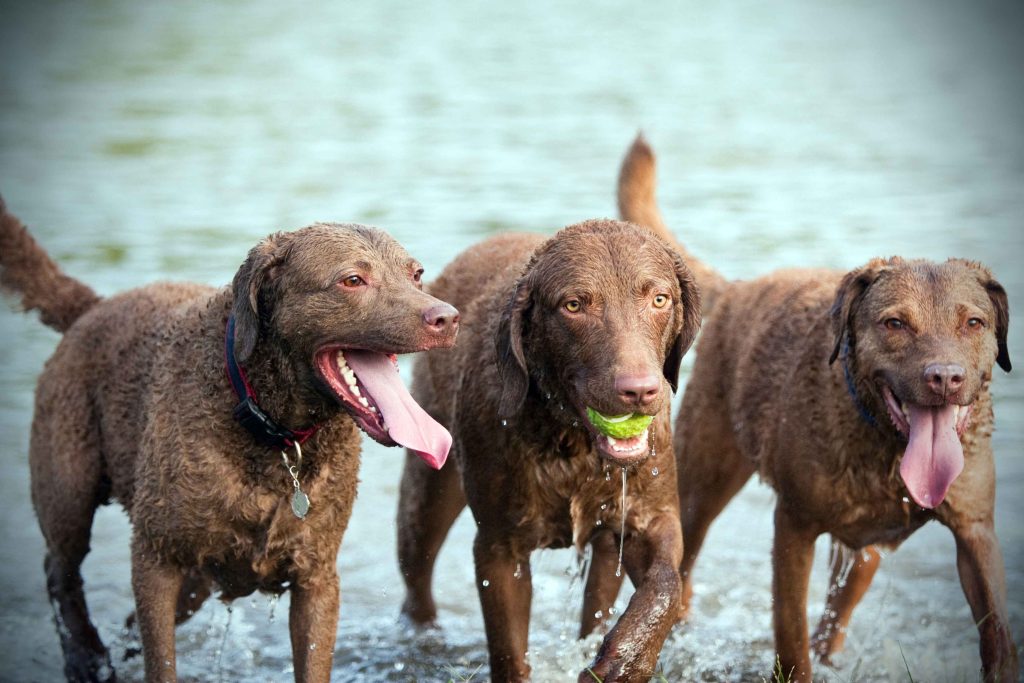
Spending most of my life with Chesapeakes, after colour the questions I receive most often is in regard to coat. It never ceases to amaze me how many people there are who believe they know all about coat and yet many of them have got it completely wrong. One of the first comments I will hear is that the coat should be very oily almost dripping in it! The natural oils in a Chesapeakes coat, produced by the thicker skin and kept more lubricated by the woolly undercoat should help the oils to rise up to the harsher outer coat. The combination of skin and two coats will help prevent the dog from holding water and aiding quicker drying. They will get wet, they may stay slightly wet, but with the thick skin and undercoat they will not feel the cold as the water should not penetrate. In short coated breeds they have nothing to hold water so dry quicker but they have very little to keep them warm. I do not refer to hot and cold on a winter’s day but of icy days to when the weather drops to below zero and the dogs may be out for several hours.
I have always had spaniels as well as Chesapeakes, finding a team of 2 Chessies and a spaniel the best combination. When I was picking up 6 days a week I would have 3 teams of this combination. The spaniels were always working bred. On a wet day they did not need to enter water to become soaked, just by working cover they will get wet and stay wet, whereas my Chesapeakes working similar cover, fields of wet roots, rivers and streams would be merely damp and dried out completely by the time we arrived home.
A good coat therefore would consist of hair that is a half-circle laid one on top of the other forms the waving pattern. An even better coat is where the hair is more crinkled, knitting the outer coat together giving even better protection. What the coat should never be is curly – this is where the hair forms a complete circle. I am seeing this more often on several dogs which is alarming and continually have people who find this misleading and perhaps has opened to door for long coated Chesapeakes to be exhibited.
When I first started breeding Chesapeakes there were so few dogs, if it was unrelated and what you believed to be healthy one would use it. Almost always these matings were outcrosses, one never quite knew what would be produced. These early breeding taught me much as many of the extremes in the breed would show up, as a result I too bred some long coats – very long coats! I did not plan to breed to long coats. I saw the breeding of correct coat as much of a challenge as any other feature in the breed. I have never bred from a long coat and have not produced long coats for over 30 years. If you are going to breed from a long coat many of the offspring will carry the long coat gene, or if you knowingly breed two long coat carriers you may produce long coats. There is nothing wrong with owning or breeding a long coat, most long coats have very biddable temperaments, but the coat is incorrect to the breed standard. Trimming, cutting and clipping long coats we are now seeing more of them being shown!
There is now, and has been for some time, a genetic test for long coat.
It is very difficult if you are judging and really don’t know coat, but please remember that coat is the most important feature of a Chesapeake with 18 points on the positive scale of the American Chesapeake Club breed standard.
Sad news from Peter Milner – Today we said our last goodbye to my wonderful great big brown bear Polotter Pickled Piper just short of his twelfth birthday(bred by Krysryna Niemcluc by CH Penrose Wise Guy x Penrose Just Like Magic). What a life we have enjoyed together – it was Piper who really got me into showing when he swept the board almost eleven years ago winning RBS at the Club Open Show and going on to win Red rosettes at Crufts, one CC plus five RCCs. Some great moments such becoming the first ever Chessie to enter and win best in the Gundog AVNSC class at the Derbyshire County Show. But better than simply winning rosettes have been the wonderful friendships we formed through showing and not just in the Chessie world. I think we might also have brought a few light moments in to your lives as we learnt and in time improved our showring techniques. And many, many other adventures away from the showring that will live with me until I too pass over. He was a true companion dog to my wife – racing into the room if he heard her drop anything at all – to pick it up and place on her knee. RIP my dear canine friend.
A disappointing entry at Bath Championship Show, always a popular venue drawing exhibitors from the South East and West. Awarding CCs in the breed for the first time was Mrs H Male, KC. 14 dogs, 5d, 9b. BOB & BCC Mayhew & Middleton’s SH CH Arnac Bay Hebe Wgc ShCEx Ew22; RBCC & BP Mayhew & Middleton’s Arnac Bay Jellicoe; DCC Mayhew & Murch’s SH CH Next Generation Arnac Arctic Storm (imp USA); RDCC Boyles’ Pixiesrock Mr Tumnus By Bleyos JW; BV Baxandall’s Sharbae Prettiest Star; BSB Herring’s Battsrock Sweet Child O Mine.