
Chesapeake Bay Retriever
Chesapeake Bay Retriever Story
During the 19th Centuary Chesapeake Bay with its 200-mile-long estuary surrounded by Maryland and Virginia, set the breed standard for the Chesapeake Bay Retriever.
The breed is thought to descend from two Newfoundland dogs named Sailor and Canton who were traveling aboard a ship bound for England in 1807. The ship ran aground, but the crew and the two dogs Sailor and Canton were rescued. Sailor found a home with John Mercer of West River and Canton with Dr. James Stewart of Sparrow’s Point. Both dogs gained a reputation as excellent water dogs, especially when it came to duck hunting, and their puppies inherited their abilities and their unusual yellowish or amber-colored eyes.
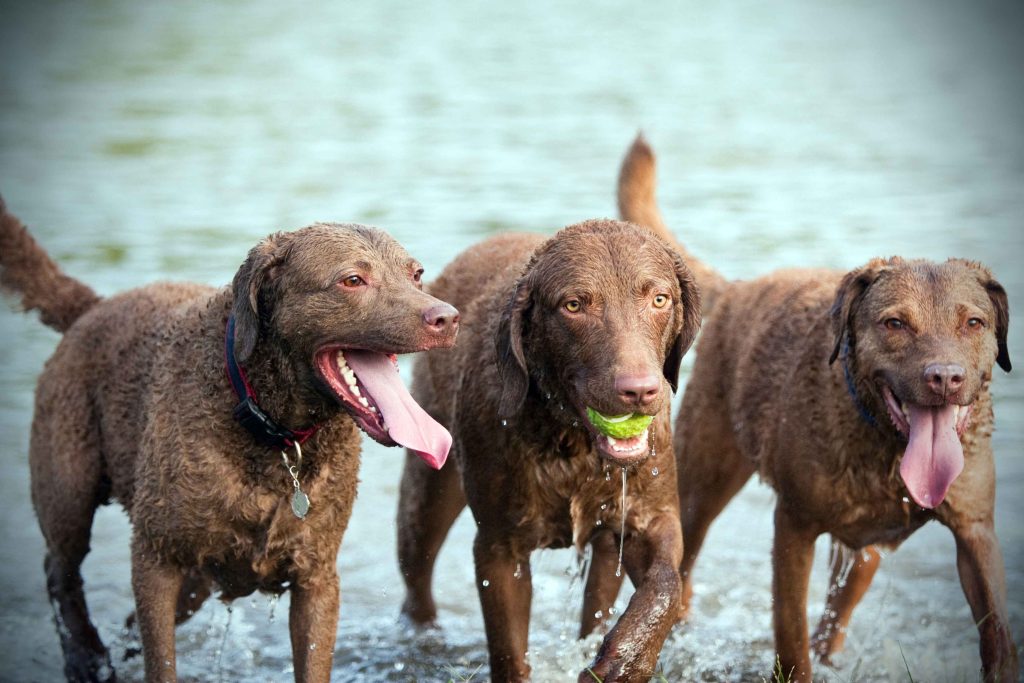
The Chesapeake Bay Retriever were well suited to Chesapeake Bay bay’s chilly waters. The Chesapeake Bay Retrievers thick, oily, double coat is both insulating and waterproof; it repels moisture much the way a duck’s feathers do. The powerful hindquarters and large webbed feet enable the Chesapeake Bay Retriever to swim tirelessly against the slashing winds that whip across Chesapeake Bay.
Happily, the Chesapeake Bay Retriever isn’t a one-trick dog. Their sturdy build and acute scenting ability are highly valued by dog handlers in the fields of search-and-rescue work. Also, the Chesapeake Bay Retrievers good looks and athleticism are employed to great advantage in show rings, field trials, working trials, agility and in a variety of other dog sports.
The American Chesapeake Club held the first licensed retriever trial in 1932. Fittingly, the front door of the Chesapeake Bay Maritime Museum in St. Michael’s, Maryland, is guarded by a pair of cast-iron statues of Chessies.
Various Internet Sources
Chesapeake Bay Retriever American Breed Standard
General Appearance:
Equally proficient on land and in the water, the Chesapeake Bay Retriever was developed along the Chesapeake Bay to hunt waterfowl under the most adverse weather and water conditions, often having to break ice during the course of many strenuous multiple retrieves.
Frequently the Chesapeake must face wind, tide and long cold swims in its work. The breed’s characteristics are specifically suited to enable the Chesapeake to function with ease, efficiency and endurance. In head, the Chesapeake’s skull is broad and round with a medium stop. The jaws should be of sufficient length and strength to carry large game birds with an easy, tender hold.
The double coat consists of a short, harsh, wavy outer coat and a dense, fine, wooly undercoat containing an abundance of natural oil and is ideally suited for the icy rugged conditions of weather the Chesapeake often works in.
In body, the Chesapeake is a strong, well – balanced, powerfully built animal of moderate size and medium length in body and leg, deep and wide in chest, the shoulders built with full liberty of movement, and with no tendency to weakness in any feature, particularly the rear. The power though, should not be at the expense of agility or stamina. Size and substance should not be excessive as this is a working retriever of an active nature.
Distinctive features include eyes that are very clear, of yellowish or amber hue, hindquarters as high or a trifle higher than the shoulders, and a double coat which tends to wave on shoulders, neck, back and loins only. The Chesapeake is valued for its bright and happy disposition, intelligence, quiet good sense, and affectionate protective nature. Extreme shyness or extreme aggressive tendencies are not desirable in the breed either as a gun dog or companion.
Disqualifications:
Specimens that are lacking in breed characteristics should be disqualified.
Height:
Males should measure 23 to 26 inches
Females should measure 21 to 24 inches.
Oversized or undersized animals are to be severely penalized.
Proportion:
Height from the top of the shoulder blades to the ground should be slightly less than the body length from the breastbone to the point of buttocks. Depth of body should extend at least to the elbow. Shoulder to elbow and elbow to ground should be equal.
Weight:
Males should weigh 65 to 80 pounds
Females should weigh 55 to 70 pounds.
Head:
The Chesapeake Bay Retriever should have an intelligent expression.
Eyes:
Eyes are to be medium large, very clear, of yellowish or amber color and wide apart.
Ears:
Ears are to be small, set well up on the head, hanging loosely, and of medium leather.
Skull:
Skull is broad and round with a medium stop.
Nose and muzzle:
Nose is medium short.
Muzzle is approximately the same length as the skull, tapered, pointed but not sharp. Lips are thin, not pendulous.
Bite – Scissors is preferred, but a level bite is acceptable.
Disqualifications:
Either undershot or overshot bites are to be disqualified.
Neck, Topline, Body:
Neck
Neck should be of medium length with a strong muscular appearance, tapering to the shoulders.
Topline
Topline should show the hindquarters to be as high as or a trifle higher than the shoulders.
Body
Back should be short, well coupled and powerful. Chest should be strong, deep and wide. Rib cage barrel round and deep.
Body is of medium length, neither cobby nor roached, but rather approaching hollowness from underneath as the flanks should be well tucked up.
Tail of medium length; medium heavy at the base . The tail should be straight or slightly curved and should not curl over back or side kink.
Forequarters:
There should be no tendency to weakness in the forequarters. Shoulders should be sloping with full liberty of action, plenty of power and without any restrictions of movement.
Legs should be medium in length and straight, showing good bone and muscle. Pasterns slightly bent and of medium length. The front legs should appear straight when viewed from front or rear. Dewclaws on the forelegs may be removed. Well webbed hare feet should be of good size with toes well – rounded and close.
Hindquarters:
Good hindquarters are essential. They should show fully as much power as the forequarters. There should be no tendency to weakness in the hindquarters. Hindquarters should be especially powerful to supply the driving power for swimming. Legs should be medium length and straight, showing good bone and muscle. Stifles should be well angulated. The distance from hock to ground should be of medium length. The hind legs should look straight when viewed from the front or rear. Dewclaws, if any, must be removed from the hind legs.
Disqualifications:
Dewclaws on the hind legs are a disqualification.
Coat:
Coat should be thick and short, nowhere over 1½ inches long, with a dense fine wooly undercoat. Hair on the face and legs should be very short and straight with a tendency to wave on the shoulders, neck, back and loins only. Moderate feathering on rear of hindquarters and tail is permissible.
The texture of the Chesapeake’s coat is very important, as the Chesapeake is used for hunting under all sorts of adverse weather conditions, often working in ice and snow. The oil in the harsh outer coat and wooly undercoat is of extreme value in preventing the cold water from reaching the Chesapeake’s skin and aids in quick drying. A Chesapeake’s coat should resist the water in the same way that a duck’s feathers do. When the Chesapeake leaves the water and shakes, the coat should not hold water at all, being merely moist.
Disqualifications:
A coat that is curly or has a tendency to curl all over the body must be disqualified. Feathering on the tail or legs over 1¾ inches long must be disqualified.
Color:
The color of the Chesapeake Bay Retriever must be as nearly that of its working surroundings as possible.
Any color of brown, sedge or deadgrass is acceptable, self – colored Chesapeakes being preferred. One color is not to be preferred over another. A white spot on the breast, belly, toes, or back of the feet (immediately above the large pad) is permissible, but the smaller the spot the better, solid colored preferred.
The color of the coat and its texture must be given every consideration when judging on the bench or in the ring. Honorable scars are not to be penalized.
Disqualifications:
Black colored; white on any part of the body except breast, belly, toes, or back of feet must be disqualified.
Gait:
The gait should be smooth, free and effortless, giving the impression of great power and strength. When viewed from the side, there should be good reach with no restrictions of movement in the front and plenty of drive in the rear, with good flexion of the stifle and hock joints. Coming at you, there should be no sign of elbows being out. When the Chesapeake is moving away from you, there should be no sign of cowhockness from the rear. As speed increases, the feet tend to converge toward a center line of gravity.
Temperament:
The Chesapeake Bay Retriever should show a bright and happy disposition with an intelligent expression. Courage, willingness to work, alertness, nose, intelligence, love of water, general quality and, most of all, disposition should be given primary consideration in the selection and breeding of the Chesapeake Bay Retriever.
Disqualifications:
- Specimens lacking in breed characteristics.
- Teeth overshot or undershot.
- Dewclaws on the hind legs.
- Coat curly or with a tendency to curl all over the body.
- Feathering on the tail or legs over 1¾ inches long.
- Black colored.
- White on any part of the body except breast, belly, toes, or back of feet. The question of coat and general type of balance takes precedence over any scoring table which could be drawn up. The Chesapeake should be well proportioned, an animal with a good coat and well balanced in other points being preferable to one excelling in some but weak in others.
Chesapeake Bay Retriever Breed Health
Hip dysplasia:
A genetic condition where the dog’s hip joint doesn’t develop properly.
This can lead to pain and osteoarthritis.
Elbow dysplasia:
A genetic condition where the dog’s elbow joint doesn’t develop properly.
This can lead to pain and osteoarthritis.
Cataracts and Progressive Retinal Atrophy (PRA):
These conditions can lead to blindness.
Degenerative Myelopathy (DM):
A disease impacting the spinal cord, causing increasing weakness and ultimately paralysis and death.
Exercise-Induced Collapse (EIC):
A genetic trait found primarily in Labradors and other breeds of retrievers.
Ectodermal Dysplasia / Skin fragility (EdSf):
Has been identified in the Chesapeake Bay Retriever
Chondrodystrophy / Invertebral Disc Disease +/- Chrondrodysplasia (CDDY / IVDD +/- CDPA):
Has been identified in the Chesapeake Bay Retriever
Chesapeake Bay Retriever Breed Health Tests
Hip & Elbow X-Rays:
These can be scored by: the BVA / KC Hip & Elbow Dysplasia Scheme or ANKC (min age 12 mths), or OFA (USA) Prelims under 12mths, Full Scoring at 2yrs.
Annual Eye Examination:
To be carried out by a BVA/KC Eye Panellist (see link below) before breeding and then annually.
DNA Testing:
For DM, PRA, EIC, EdSF & CDDY / IVDD +/- CDPA can be carried out by various Laboratories, including Laboklin, Animal Genetics and Paw Prints Genetics (USA)
Where To Meet A Chessapeake Bay Retriever
Title
Content here. Lorem ipsum dolor sit amet, consectetur adipiscing elit. Vestibulum tincidunt pharetra risus, in facilisis sem imperdiet vitae. In nec iaculis ex. Proin rhoncus massa nec felis blandit varius. Phasellus in arcu justo. Sed ultrices turpis a massa congue ultrices. Duis id dolor eget magna luctus luctus quis quis urna. Vivamus luctus mi orci, ut iaculis velit fringilla sed. Pellentesque eu dolor tincidunt, facilisis metus blandit, ullamcorper ligula. Praesent nec pharetra nibh.
Sed varius consectetur nisi. Sed vitae tellus vel tellus congue luctus. Ut dignissim nisi felis, ornare condimentum leo sodales sit amet. Nulla maximus mollis orci, non elementum nisl laoreet sed. Aliquam pellentesque fringilla augue quis condimentum. Ut at neque ac diam cursus ullamcorper at et neque. Nam sagittis molestie lacus quis gravida. Curabitur nec metus in lacus commodo varius. Nam in massa eget elit consequat elementum quis nec quam. Interdum et malesuada fames ac ante ipsum primis in faucibus. Curabitur non ipsum in ex efficitur tincidunt quis nec tortor. Maecenas tristique tincidunt massa ut rhoncus. Nam feugiat diam non fermentum tempus. Sed et dapibus neque. Fusce mauris justo, convallis a maximus eu, pharetra vitae nisl. Suspendisse viverra mi quam, vitae egestas libero tristique sed.
Living With A Chessapeake Bay Retriever
Title
Content here. Lorem ipsum dolor sit amet, consectetur adipiscing elit. Vestibulum tincidunt pharetra risus, in facilisis sem imperdiet vitae. In nec iaculis ex. Proin rhoncus massa nec felis blandit varius. Phasellus in arcu justo. Sed ultrices turpis a massa congue ultrices. Duis id dolor eget magna luctus luctus quis quis urna. Vivamus luctus mi orci, ut iaculis velit fringilla sed. Pellentesque eu dolor tincidunt, facilisis metus blandit, ullamcorper ligula. Praesent nec pharetra nibh.
Sed varius consectetur nisi. Sed vitae tellus vel tellus congue luctus. Ut dignissim nisi felis, ornare condimentum leo sodales sit amet. Nulla maximus mollis orci, non elementum nisl laoreet sed. Aliquam pellentesque fringilla augue quis condimentum. Ut at neque ac diam cursus ullamcorper at et neque. Nam sagittis molestie lacus quis gravida. Curabitur nec metus in lacus commodo varius. Nam in massa eget elit consequat elementum quis nec quam. Interdum et malesuada fames ac ante ipsum primis in faucibus. Curabitur non ipsum in ex efficitur tincidunt quis nec tortor. Maecenas tristique tincidunt massa ut rhoncus. Nam feugiat diam non fermentum tempus. Sed et dapibus neque. Fusce mauris justo, convallis a maximus eu, pharetra vitae nisl. Suspendisse viverra mi quam, vitae egestas libero tristique sed.