
American Water Spaniel
American Water Spaniel Story
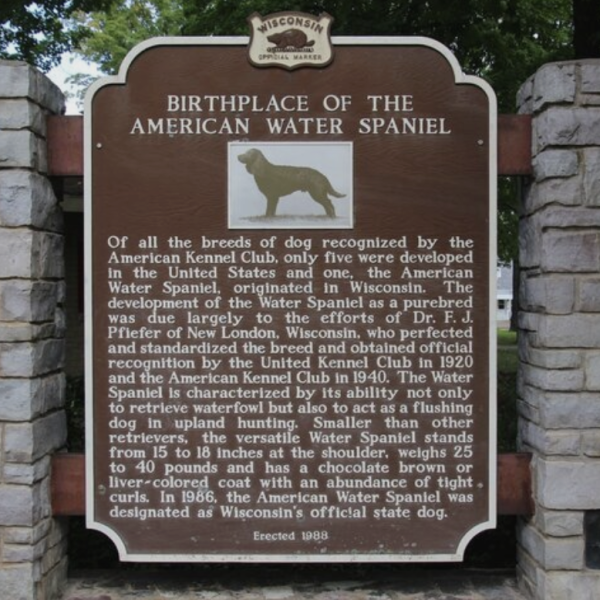
Originating in Wisconsin, the American Water Spaniel is the Wisconsin state dog. The breed originated in the areas along the Fox River and its tributary the Wolf River during the early 19th century. Hunters needed a dog that could work on both land and water, a versatile hunter skilled at bringing in a variety of game. Hunters also wanted a hunting dog compact enough to be transported in a small skiff, one that was able to withstand Wisconsin’s cold water temperatures. Breeds involved in the creation of the American Water Spaniel are thought to have included the English Water Spaniel, Irish Water Spaniel, Curly Coated Retriever, native Indian Dogs, the Poodle, and either the Sussex Spaniel or another type of field spaniel.
This little brown dog created was known at the time as the American Brown Spaniel, and weighed around 40 pounds (18 kg). It had a thick curly coat that protected it from the cold temperatures of the water and winter. It was used to hunt waterfowl, ruffed grouse, greater prairie chicken and a variety of fur–bearing animals.
An American Water Spaniel’s coat is water resistant
Over the years the numbers of the breed began to dwindle due both to a reduction in the duck population through those valley areas, and because of a switch in hunting – from a means to gather food for survival to that of recreation. Additionally, following World War II, new types of dogs became available in Wisconsin such as setters, pointers and other spaniels, allowing additional specialization in hunting.
Dr. Fred J. Pfeifer, from New London, Wisconsin, set up Wolf River Kennels in order to save the breed. Numbers held by the kennel fluctuated but at times went up to 132 dogs. He advertised the dogs widely across the country, selling male dogs for $25 and females dogs for $20. Part of a sales pitch that Pfeifer mailed to prospective dog owners read, “The American Brown Spaniel is distinctively an American production. Hunters have known this type for years and it was through their efforts that this dog was propagated. For years the have bred only selective stock, breeding for gameness, stability, courage, intelligence, and beauty. They are dogs to admire and trust under all conditions whether in the home circle or in the field with the outdoor man.”
Due to Pfeifer’s work, the breed was recognized by the United Kennel Club (UKC) as the American Water Spaniel in 1920, and by the Field Dog Stud Book in 1938. Pfeifer’s own dog, named “Curly Pfeifer” was the first American Water Spaniel to be registered with UKC. John Scofield of Missouri and Thomas Brogdan of Rush Lake, Wisconsin worked together with the American Water Spaniel Club (AWSC), gaining the breed recognition with the American Kennel Club (AKC) in 1940. Prior to recognition by the AKC, the breed had not been shown in the show ring.
American Water Spaniel Breed Standard
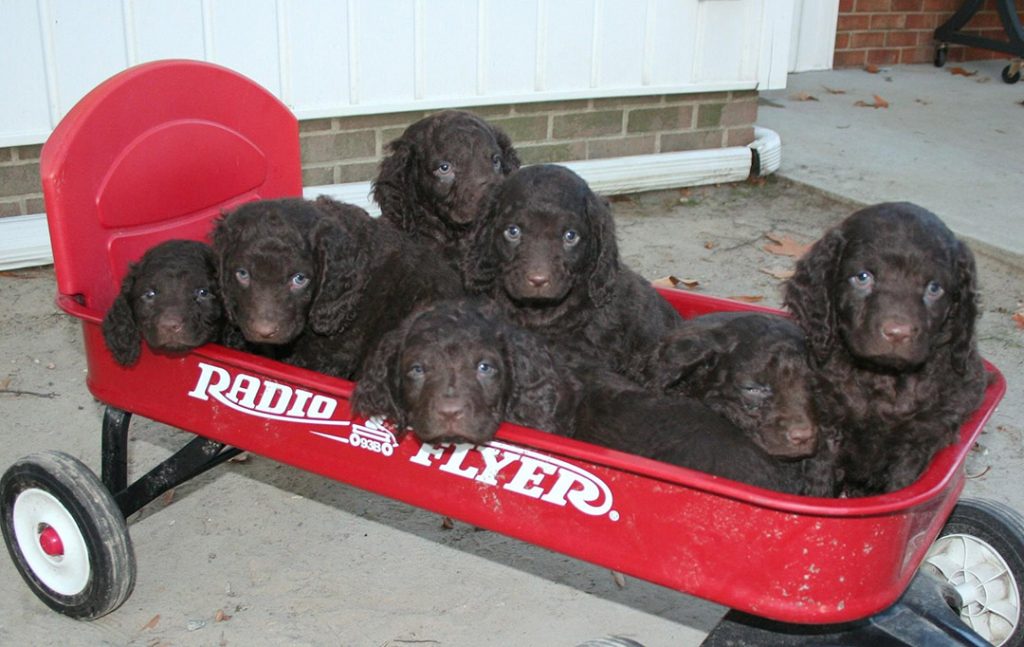
General Appearance:
The American Water Spaniel was developed in the United States as an all-around hunting dog, bred to retrieve from skiff or canoes and work ground with relative ease.
The American Water Spaniel is an active muscular dog, medium in size with a marcel to curly coat. Emphasis is placed on proper size and a symmetrical relationship of parts, texture of coat and colour.
Size, Proportion, Substance:
15 to 18 inches for either sex. Males weighing 30 to 45 pounds.
Females weighing 25 to 40 pounds. Females tend to be slightly smaller than the males. There is no preference for size within the given range of either sex providing correct proportion, good substance and balance is maintained. Proportion – is slightly longer than tall, not too square or compact. However, exact proportion is not as important as the dog being well-balanced and sound, capable of performing the breed’s intended function. Substance – a solidly built and well- muscled dog full of strength and quality. The breed has as much substance and bone as necessary to carry the muscular structure but not so much as to appear clumsy.
Head:
The head must be in proportion to the overall dog. Moderate in length. Expression is alert, self-confident, attractive and intelligent. Medium size eyes set well apart, while slightly rounded, should not appear protruding or bulging. Lids tight, not drooping. Eye colour can range from a light yellowish brown to brown, hazel or of dark tone to harmonise with coat.
Disqualify yellow eyes. Yellow eyes are a bright colour like that of lemon, not to be confused with the light yellowish brown.
Ears set slightly above the eye line but not too high on the head, lobular, long and wide with leather extending to nose. Skull rather broad and full, stop moderately defined, but not too pronounced.
Muzzle moderate in length, square with good depth. No inclination to snipiness, the lips are clean and tight without excess skin or flews. Nose dark in colour, black or dark brown.
The nose sufficiently wide and with well-developed nostrils to insure good scenting power. Bite either scissor or level.
Neck, Topline, Body:
Neck round and of medium length, strong and muscular, free of throatiness, set to carry head with dignity, but arch not accentuated. Topline level or slight, straight slope from withers.
Body well-developed, sturdily constructed but not too compactly coupled. Well-developed brisket extending to elbow neither too broad nor too narrow. The ribs well-sprung, but not so well-sprung that they interfere with the movement of the front assembly. The loins strong, but not having a tucked-up look. Tail is moderate in length, curved in a rocker fashion, can be carried either slightly below or above the level of the back. The tail is tapered, lively and covered with hair with moderate feathering.
Forequarters:
Shoulders sloping, clean and muscular. Legs medium in length, straight and well- boned but not so short as to handicap for field work or so heavy as to appear clumsy. Pasterns strong with no suggestion of weakness. Toes closely grouped, webbed and well-padded. Size of feet to harmonise with size of dog. Front dewclaws are permissible.
Hindquarters:
Well-developed hips and thighs with the whole rear assembly showing strength and drive. The hock joint slightly rounded, should not be small and sharp in contour, moderately angulated. Legs from hock joint to foot pad moderate in length, strong and straight with good bone structure. Hocks parallel.
Coat:
Coat can range from marcel (uniform waves) to closely curled. The amount of waves or curls can vary from one area to another on the dog. It is important to have undercoat to provide sufficient density to be of protection against weather, water or punishing cover, yet not too coarse or too soft. The throat, neck and rear of the dog well-covered with hair. The ear well- covered with hair on both sides with ear canal evident upon inspection. Forehead covered with short smooth hair and without topknot. Tail covered with hair to tip with moderate feathering. Legs have moderate feathering with waves or curls to harmonise with coat of dog. Coat may be trimmed to present a well groomed appearance; the ears may be shaved; but neither is required.
Colour:
Colour either solid liver, brown or dark chocolate. A little white on toes and chest permissible.
Gait:
The American Water Spaniel moves with well-balanced reach and drive. Watching a dog move toward one, there should be no signs of elbows being out. Upon viewing the dog from the rear, one should get the impression that the hind legs, which should be well-muscled and not cowhocked, move as nearly parallel as possible, with hocks doing their full share of work and flexing well, thus giving the appearance of power and strength.
Temperament:
Demeanour indicates intelligence, eagerness to please and friendly. Great energy and eagerness for the hunt yet controllable in the field.
Disqualifications:
Yellow eyes.
Approved March 13, 1990 by the AKC
Effective May 1, 1990
American Water Spaniel Breed Health
Hip dysplasia:
A genetic condition where the dog’s hip joint doesn’t develop properly. This can lead to pain and osteoarthritis.
Cataracts and Progressive Retinal Atrophy (PRA):
These conditions can lead to blindness.
Where To Meet An American Water Spaniel
Title
Content here. Lorem ipsum dolor sit amet, consectetur adipiscing elit. Vestibulum tincidunt pharetra risus, in facilisis sem imperdiet vitae. In nec iaculis ex. Proin rhoncus massa nec felis blandit varius. Phasellus in arcu justo. Sed ultrices turpis a massa congue ultrices. Duis id dolor eget magna luctus luctus quis quis urna. Vivamus luctus mi orci, ut iaculis velit fringilla sed. Pellentesque eu dolor tincidunt, facilisis metus blandit, ullamcorper ligula. Praesent nec pharetra nibh.
Sed varius consectetur nisi. Sed vitae tellus vel tellus congue luctus. Ut dignissim nisi felis, ornare condimentum leo sodales sit amet. Nulla maximus mollis orci, non elementum nisl laoreet sed. Aliquam pellentesque fringilla augue quis condimentum. Ut at neque ac diam cursus ullamcorper at et neque. Nam sagittis molestie lacus quis gravida. Curabitur nec metus in lacus commodo varius. Nam in massa eget elit consequat elementum quis nec quam. Interdum et malesuada fames ac ante ipsum primis in faucibus. Curabitur non ipsum in ex efficitur tincidunt quis nec tortor. Maecenas tristique tincidunt massa ut rhoncus. Nam feugiat diam non fermentum tempus. Sed et dapibus neque. Fusce mauris justo, convallis a maximus eu, pharetra vitae nisl. Suspendisse viverra mi quam, vitae egestas libero tristique sed.
Living With The American Water Spaniel
Title
Content here. Lorem ipsum dolor sit amet, consectetur adipiscing elit. Vestibulum tincidunt pharetra risus, in facilisis sem imperdiet vitae. In nec iaculis ex. Proin rhoncus massa nec felis blandit varius. Phasellus in arcu justo. Sed ultrices turpis a massa congue ultrices. Duis id dolor eget magna luctus luctus quis quis urna. Vivamus luctus mi orci, ut iaculis velit fringilla sed. Pellentesque eu dolor tincidunt, facilisis metus blandit, ullamcorper ligula. Praesent nec pharetra nibh.
Sed varius consectetur nisi. Sed vitae tellus vel tellus congue luctus. Ut dignissim nisi felis, ornare condimentum leo sodales sit amet. Nulla maximus mollis orci, non elementum nisl laoreet sed. Aliquam pellentesque fringilla augue quis condimentum. Ut at neque ac diam cursus ullamcorper at et neque. Nam sagittis molestie lacus quis gravida. Curabitur nec metus in lacus commodo varius. Nam in massa eget elit consequat elementum quis nec quam. Interdum et malesuada fames ac ante ipsum primis in faucibus. Curabitur non ipsum in ex efficitur tincidunt quis nec tortor. Maecenas tristique tincidunt massa ut rhoncus. Nam feugiat diam non fermentum tempus. Sed et dapibus neque. Fusce mauris justo, convallis a maximus eu, pharetra vitae nisl. Suspendisse viverra mi quam, vitae egestas libero tristique sed.